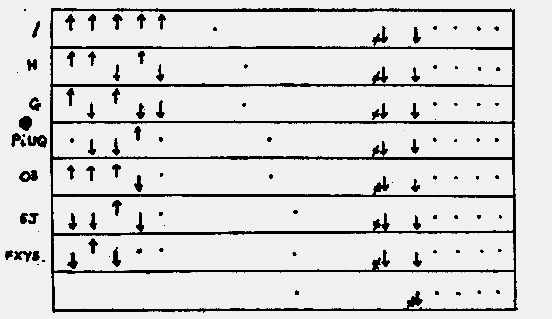
(ii) / H 0 3 G P I U Q 5 J F X Y S as a single run
If this were done in a hurry it would be very easy to overlook that
PIUQ can be switched in a single row; if PI, UQ were in separate runs it would not
matter, but it is necessary to put some of the fifteen letters together, for there
are only 10 rows.
(g) Possible Runs
This suggests the problem of whether all possible sets of conditions
can be imposed on Q, i.e. whether it is possible to run for an entirely arbitrary
selection of letters from the 32 letter alphabet.
It is obviously possible to run for any ten letters but, for example,
R A S H D 0 N 8 L I Z , 11 letters, is impossible.
Despite the aid of the addition switches, 15 rows in the upper part of
panel are needed to include all runs.
(h) The R Switches
These are the multiple test switches carrying the impulses
R1,R2,R3,R4,R5 [ see Multiple Test 53L(c)] : each occurs in two rows in the upper
part of the panel and in one row in the lower part.
Evidently the choice of runs will be much more restricted on multiple
test than without it.
For examples of multiple test switching see 53 L(1)
(i) Total Motor Switch
In the bottom row of the Q panel is a three-way switch whose active
positions are labelled TM . and TM x .
This switch is not used for motorizing, but only for counting against
TM = . or TM = x . It is rather more general than this, for by use of the
limitation determiner switches TM can be made to mean