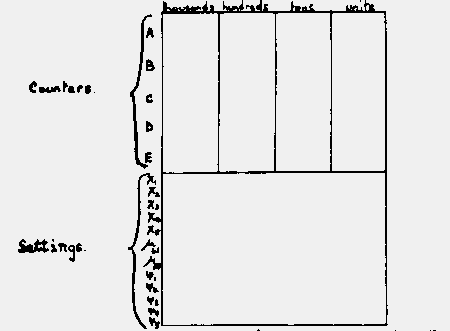
Scores which are to be printed, together with the relevant settings are
stored on relays and appear on a display. While the next count is being made these
relays send impulses to the printer and so clear themselves. If the printing is
not completed in time to clear the relays for the next score, stepping is
automatically inhibited until the relays are clear: thus no scores are lost.
(d) The Display
The display is a glass screen on which the scores are projected by small
electric lamps.
The switch LC/o cuts out the "settings" lamps. The switch ML
extinguishes the "settings" lamps when all scores in storage have been printed.
(e) Printing of settings
When the machine is started it prints in a horizontal row the symbols for
all wheels which are stepping. In the printed record the settings of these
stepping wheels appear before every score. Each below its appropriate heading.
when runs are done simultaneously, some of these settings may be relevant to
certain runs only. To avoid the printing of confusingly meaningless settings there
is a 5 x 12 array of jacks to the right of the X setting jacks, whose rows
correspond to the 5 counters, and 12 columns to the 12 wheels: in order that a
score on a particular counter shall cause the setting of a particular wheel to be
printed, a shorting plug must be inserted in the corresponding jack.
In all cases the name (a, b, c, d, e) of the appropriate counter is printed
before each score.
(f) Printing of Scores
After a score is printed there is an automatic carriage return so that each
score is on a separate line.
(g) "Print Main Headings". (PMH switch on control panel).
Prints the settings of all 12 wheels, each following its appropriate
symbol. Colossus has to be restarted after printing the symbols.