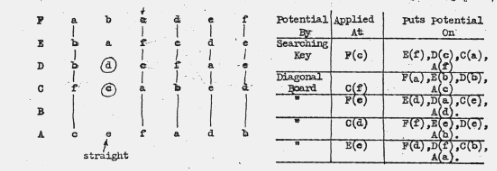
There is no potential on the remaining path and the machine stopped
indicating that at the particular wheel order and relative
ringstellung a stecker of A to E would meet the condition. B to F
does not apply because B in not on the menu. C and D are self
steckered.
PREPARATION OF MENU.
A menu is a means of preparing information in pictorial form for
the setting up of the bombe. Referring back to the intercepted message
and assumed text on page 3, the following would be a menu prepared to
"break" this message.
OMP QTC
ZZZ ABCDE FGHIJ K
NLPGA REHMB TODPQ
ANXRO BINS0 N
++ ++ + + + +
Fig. 9. Typical Menu.
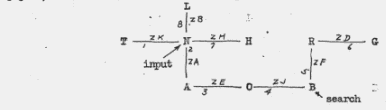
N was selected as the letter on which to build the menu because it
occurs most frequently within the crib. Under wheel position ZZB N
decodes as L, at ZZK as H, and at ZZK as T. The input of a menu is
the letter joining the most closures ,or the largest number of links.
This input is put at N as the point from which the menu is most
electrically balanced. The search point is selected as the second
best input position and must be 2 or more links away from the input,
to ensure best performance of the bombe. This search point is put at
B to reduce current flow through enigmas between N-A, A-O, O-B. The
German SOP is to change starting position every 250 letters.
The menu should be numbered in one continuous chain, making
sure that the commons will be between numbers at the beginning or end
of the bank of enigmas when possible. Commons should not be used in a
closure unless absolutely necessary. Always start numbering at the
end of a chain, or part of the menu where an odd number of enigmas
converge, to avoid the use of an extra lead and/or common. A good
general principle is to so number the menu that the operator can
plug it up using the minimum number of cords and commons.