It would be impossible to 'break" a message within
reasonable time by all possible enigma machine combinations by hand
processes. If it were attempted the following would be a likely
procedure.
Any particular enigma machine setting involves 4 unknowns
to the person "breaking" the message, namely - "stecker board
patching", "wheel order", "ringstellung", and "starting point". Since
stecker board patching is the largest variable, it is more efficient
to make assumptions as to the other unknowns and try all possible
patching combinations.
Ringstellung has 2 effects; (a) it changes the position
of the "turnover point" at which the slower wheel is advanced by a
faster wheel, and (b) it changes the designation of the "starting
point" of the wheel. The first effect can be neglected by choosing a
portion of the message (crib) sufficiently small to assume that no
turnover took place. The second effect can be determined on a
relative basis by setting all ringstellungs to a preselected point
and finding a relative starting point.
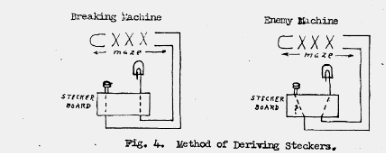
The hand process then resolves into assuming a wheel
order and starting point and solving for a stecker board patching
that will give the assumed text. This is best done by using an enigma
machine with "self steckering" (straight patching) on the stecker
board as shown below.
Starting with the first pair of letters in the cipher and assumed
text (N/A), the first step is to assume that A is steckered to B. In
order to determine what transposition takes place when B is put into
the maze, we press key B and get lamp X. If our assumption that A is
steckered to B is right, then X had to be steckered to N to give the
encodement of A indicated by the message. Let us now verify this.
Press key X. According to our previous assumptions this is steckered
to N and should give the same effect as pressing key N on the enemy
machine for the 2nd pair of letters (L/N). Suppose the Q lamp lights.
Then Q would have to be steckered to L. Press key N. According to
previous assumptions this is steckered to X and would give the same
effect as pressing key X on the enemy machine for the 3rd pair of
letters (P/X). Suppose L lamp lights. Then P would have to be
steckered to L but this is a contradiction of the result obtained for
the 2nd pair of letters.
It is then necessary to start the process over by making
a new assumption that A is steckered to C and going through The
process until no contradiction is obtained after all 26 assumptions
have been made.
If no good results are obtained, assume a new starting
point. Having exhausted the possibilities of starting points assume
new wheel orders.